
General
Units conduct attacks using either their Anti-Personnel Firepower (APFP) or Anti-Tank Firepower (ATFP) ratings, whichever is appropriate. Each unit may only attack once per turn (Exception: Close Assaults).
Direct and Indirect Fire
For simplicity’s sake, V&V considers all combat on the map to be direct fire. Even artillery Guns, which are typically known as indirect fire weapons, are used as direct fire weapons. They are simply being used in an improvised capacity, with the crew firing over open sights at targets within their LOS.
Range and LOS
A unit may fire on a target to which it has range and LOS. The range is the number of hexes from the firing unit to the target unit, counting the target unit(s) hex, but not the firing unit(s). A Gun has no range limit, and may target a unit anywhere on the board as long as the unit has an unblocked LOS to the target.
Cover (Terrain) Modifiers
The cover (terrain) modifier of the target hex is added to the attacker’s dice roll. Units in a fortification or entrenchment (see Fortifications and Entrenchments) add the position’s cover modifier to the attacker’s dice roll. Hex and hexsides between the attacking unit(s) and the target hex that contain hindrances will further modify the
attack dice roll, and hindrance modifiers are cumulative.
Gun Shields
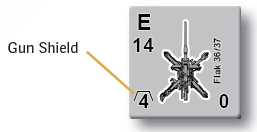
A Gun Shield provides extra protection to the inherent crew of the Gun, but only when attacked from within the Gun’s FFA, and only when the Gun is not moving. Guns with a Gun Shield ignore the first Casualty Point from AP fire, and when attacked by AT fire the Gun Shield provides a +1 cover modifier. A Gun Shield’s protection
against AT attacks is cumulative with the cover modifier of the hex or fortification the unit occupies.
Leadership Modifiers
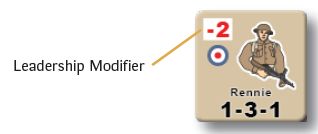
A leader in the same hex with an attacking infantry unit or fire group may modify the attack dice roll (AP or AT) with his Leadership Modifier. A leader may modify his own attack when firing alone. If there are multiple leaders in a fire group, the best leadership modifier is used.
LOS and Firing Through Occupied Hexes
Units have no effect on LOS or combat. Units may trace LOS and fire through hexes occupied by other units, friendly or enemy, with no detriment.
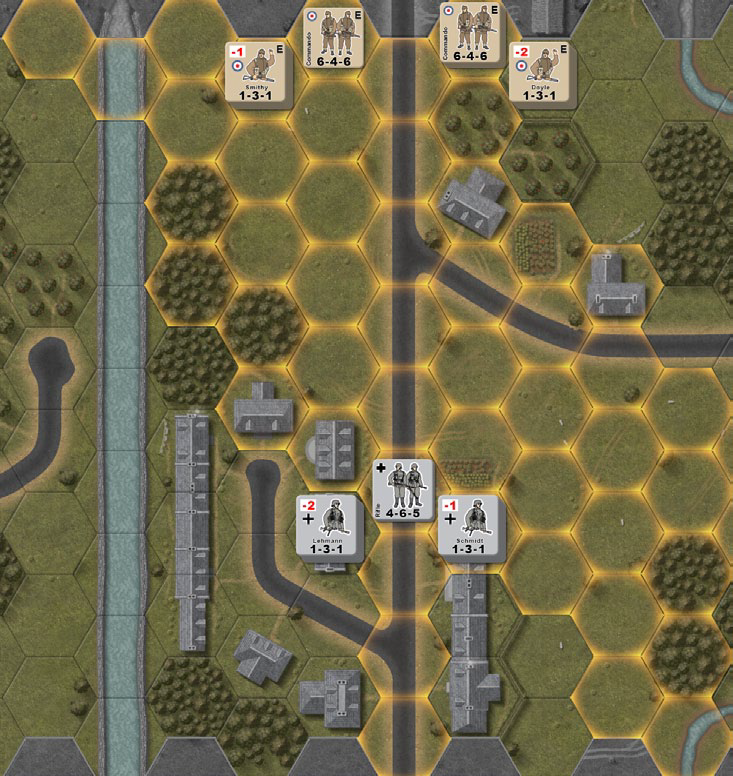
Players may check line of sight using the LOS Tool, in the Bottom Menu of the Battle Interface. The player simply presses the LOS Tool then selects a hex on the map. The tool will highlight all hexes that are within line of sight of the selected hex.

Opportunity Fire
Opportunity fire is a form of defensive fire that is used in reaction to the movement of a unit or stack during the opposing player’s Movement Phase. When a unit or stack moves, any enemy unit that has LOS to that unit, and has not previously fire, may conduct an Opportunity Fire attack on that unit or stack. If the moving unit enters a hex containing other, non-moving friendly units, only the moving unit may be targeted, or affected by, the Opportunity Fire attack.
If a unit is pinned or immobilized (AFVs only) while moving through a friendly hex already stacked to its limit the unit is eliminated.
Any targeted unit still eligible to move (i.e. not pinned), including units moving as a stack, may continue to do so after the Opportunity Fire attack is resolved.
APFP Opportunity Fire attacks versus units where no terrain or hindrance modifiers apply receive a –1 dice roll modifier, and a –2 modifier applies versus units in an adjacent hex, regardless of (and in addition to) applicable terrain effects.
Opportunity Fire attacks are conducted automatically by the computer. This is done to simplify and speed up play and to create a better play-by-email experience.
MG Fire Lanes
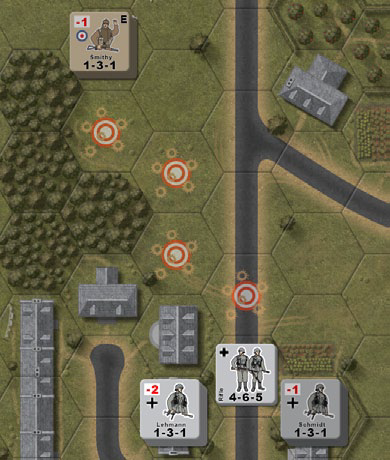
Opportunity Fire attacks that are conducted by an infantry unit with an MG support weapon will establish a fire lane. AFV and vehicle MGs cannot create fire lanes. The fire lane extends from the firing hex to the target hex. A Fire Lane is marked by a series of markers in each hex along the original LOS, including the target hex, but not the firing unit’s hex. Infantry, Gun, or unarmored vehicle units that enter a fire lane hex are immediately attacked using the 1-4 row of the AP Combat Table. No combat or cover modifiers apply, as units are considered to be entering an established fire lane. Units already occupying a fire lane when it is established are not affected; a unit is only affected when entering a fire lane hex. Fire Lane markers are removed at the end of the current Move Phase.
Fire Lane Crossfire
Multiple Fire Lane markers may be placed in a hex, if Opportunity Fire attacks from multiple machine guns affect the same hexes. If multiple machine guns from the same hex fire along the same path, each hex in the fire lane would receive multiple Fire Lane markers, one per machine gun. Each additional Fire Lane marker in a hex, after the first, subtracts –1 from the fire lane’s attack. For instance, if two machine guns conduct an Opportunity Fire attack and their fire lanes cross, causing two Fire Lane markers to be placed in the crossfire hex, that hex would attack on the 1-4 row of the AP Combat Table and receive a –1 modifier.


