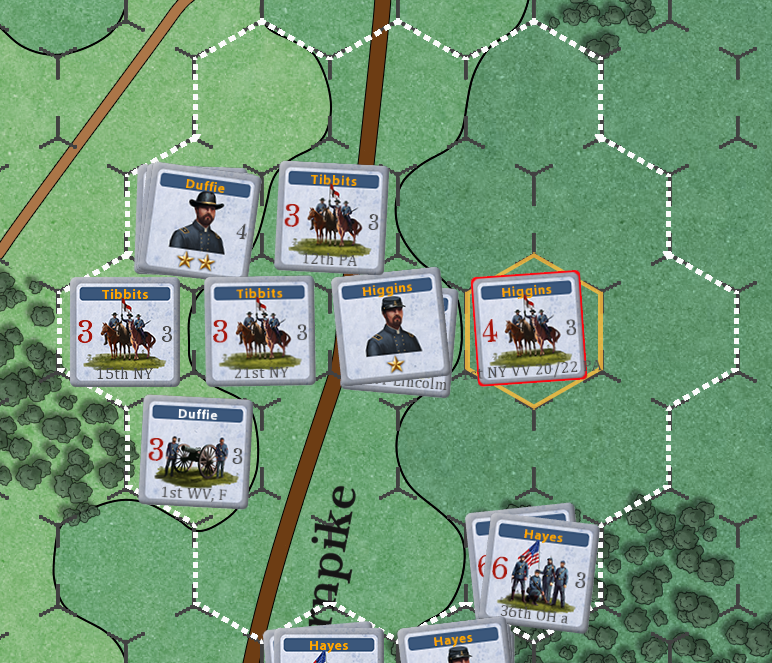
The armies each have a chain of command starting with the army commander at the top. Directly subordinate to him are corps commanders (with 3 stars on their counters). Subordinate to the corps commanders are division commanders (2 stars) who are part of that corps. Subordinate to the division commanders are the brigade commanders (1 star) of that division. Regiments are subordinate to their brigade commanders.




An army’s organization may be different in some games. An army may, for instance, be a single corps where the army commander has division commanders subordinate to him and no corps commanders.
- Commanders from the division up have a Command Value (CV) printed on their counter. This value may be used to give a DRM in combat, assist in reorganizing disorganized units, and to determine if the commander may place his subordinates in command. No commander may place his subordinates in command unless he is himself in command.
- Command determination begins with the Army Commander. Unless noted otherwise in the scenario’s rules, he may issue commands if a die roll is equal to or less than his CV. An army commander has a command range of 8 hexes (not movement points), and if he passes his Command Roll, he may place any subordinate commander within that range in command. If he fails his CV roll, all subordinate commanders may only be in command on their own initiative.
- Corps commanders (3-stars) within the command range of their army commander must roll their CV or less to be in command and may subtract one from that die roll. This represents, basically, whether they accept their orders and do what they’re told, or not.
**NOTE** All game die rolls are done behind the scenes
If they are outside of command range, or their superior is not in command, the die roll is unmodified and must be their CV or less to be in command on their own initiative.
If they fail their roll, they are NOT in command and cannot place subordinate commanders in command.
Corps and division commanders have a command range of 5 hexes.
- Division commanders (2 stars), like corps commanders, must roll to see if they accept their orders and are therefore in command. Again, if they are in command range, subtract 1 from the roll, and do not modify the roll if their corps commander is not in command, or they are outside of his command range. Additionally, for each shattered brigade and/or brigade in their division that is outside of their command range, one is added to their Command. For instance, a division commander 6 hexes from his corps commander with one of his brigades shattered, and another out of his command range, would add 2 to the Command die-roll to determine if he is in command on his own initiative.
- Brigade commanders (1 star) are in command if they are within 5 hexes (8 hexes for cavalry commanders) of their division commander, if he is in command. Brigade commanders do not have a Command Value and do not roll to accept orders or for initiative. If they are out of range of their division commander or their division commander is not in command, the brigade commander is therefore not in command and his regiments may not enter a ZOC.
- Regiments are considered to be in command when they are within the 2 hex command range of their brigade commander (if he is in command) or adjacent to another regiment of their own brigade that itself is in command.
A brigade may span more hexes than the brigade commander’s command range and still be completely in command as each regiment passes the word to its neighbor.
Artillery units are in command if they are in range of any incommand commander in their corps or division, or the army commander.
Brigade commanders may only put regiments of their own brigade and artillery of their division, or corps in command.
- Brigade commanders must always be stacked with a regiment of their brigade. If there are none, they are moved to their immediate superior commander’s hex until they manage to recover a regiment from the eliminated units.
- Any commander that is in command automatically places ANY lower-ranked commander and any units he is stacked with, in command regardless of command structure and without a die roll.
Therefore, Longstreet (ANV I Corps 3-star), if in command and stacked in the same hex with Early (ANV II Corps 2-star), would place him in command without Early needing to perform a Command roll. Any regiments or artillery in that hex are also in command. Note: adjacent regiments of the same brigade, by virtue of regiments passing command, would then also come under command, and so, potentially, the whole brigade could be in command.
Had Longstreet not been in command for whatever reason, Early would still roll for his normal command acceptance if in range of his commander, or his own initiative, if not.
By clicking on the command range button and selecting a unit, you can tell if it’s within command range