
Close assaults may be conducted by infantry units against an adjacent, enemy-occupied hex. Close assaults occur during the Advance and Assault Phase, and may only be performed by infantry units that did not advance. A unit may conduct a close assault even if it previously moved or fired in the turn.
Close assaults may be conducted against any type of unit. A close assault affects all units in the target hex, and all units in the target hex defend against the assault. Only infantry units from the same hex may close assault together; they may not combine with infantry units from separate hexes. A player does not have to assault with all of his units; he may assault with as many, or as few, as he feels necessary. Any number of close assaults may be conducted against the same hex during the same turn, but each close assault must be resolved separately, and from a separate assault group.
Assaulting Pinned Units
Pinned units are automatically eliminated when close assaulted, and are immediately removed from the game. They are not included in the odds calculation for the assault. Pinned units do not affect assaulting units (i.e., they do not contribute to casualties versus assaulting units). If a target hex contains only pinned units, the pinned units are eliminated and removed, and the assaulting units automatically take the target hex; no assault dice roll is necessary, and the assaulting units suffer no casualties as a result of the assault.
Support Weapon Restrictions
Assaulting units may only use Light (L) machine guns, grenades, and satchel charges. Defending infantry units may use any support weapon, within normal support weapon or close assault restrictions.
Close Assault Leadership Modifiers
Assaulting units subtract a leader’s Leadership Modifier from their assault dice roll. The defending units subtract a Leadership Modifier from the Kill Number before the assault is resolved. Each side may only use one Leadership Modifier per close assault resolution. If multiple leaders are present, the one with the greatest Leadership Modifier is used.
Defending AFV, Vehicle, and Passenger Restrictions
A defending AFV or vehicle may only use APFP from machine guns; the APFP of a main Gun may not be used when defending a close assault. An AFV or vehicle carrying passengers always adds the infantry unit(s) APFP rating(s) to its total, including any Light (L) machine guns, grenades, and satchel charges the player wishes to use.
Close Assault Procedure
Players may conduct close assaults with any units that have not already advanced.
To execute a close assault, the player:
★★ Selects a hex containing friendly units
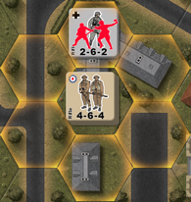
★★ Selects the units they want to assault in the Unit Selection Popup
★★ Select the hex to assault
The APFP ratings of the assaulting and defending units are totaled and compared. The ratio of the assaulting APFP to the defending APFP is called the odds ratio (fractions are rounded down). For example, if the attacking player’s APFP rating is 14 to the defender’s 6, the odds are two to one (2–1). If the odds were reversed,
with an attacking APFP of 6 versus the defender’s 14, the ratio would be one to two (1–2). Odds greater than four to one (4-1) are resolved at 4–1, and odds lower than one to four (1-4) are resolved at 1–4. The Close Assault Table is used to resolve attacks. The table has a list of various odds ratios along the top. Below each odds is a
number, called the Kill Number. A “roll” of two dice must produce a number less than or equal to this number in order for the attack to succeed.
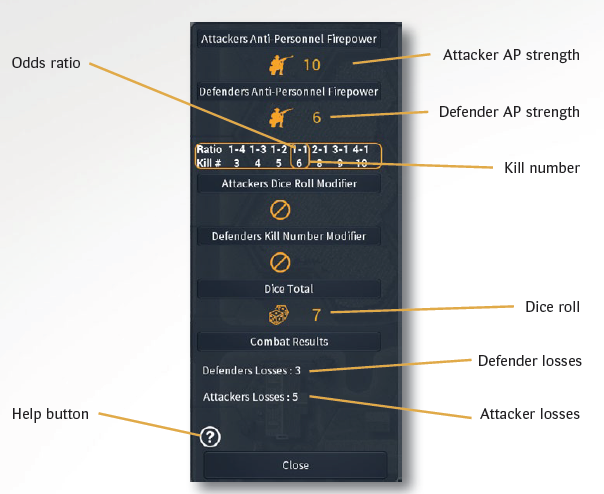
The assault is then resolved by the roll of two dice. The game then consults the Close Assault Table and cross-references the dice roll and the odds to determine the result.
Resolution
The game simulates the dice roll and adds any applicable modifiers. Cover modifiers do not apply to close assaults. The dice roll is reduced using the Leadership Modifier of best leader in the assaulting units. The Kill Number is reduced using the Leadership Modifier of the best leader in the defending hex. If the modified dice roll is equal to or less than the Kill Number, the defending units are eliminated. Once the combat is resolved, the computer applies the losses to each side in the same way as described in the AP Combat section. If the attacker wins the combat, all defender units are immediately eliminated.
Taking Ground and Taking Casualties
If the defending units are eliminated, the assaulting units immediately occupy the vacant hex. However, the attacking units suffer Casualty Points equal to the cover modifier of the hex assaulted (including any hexside terrain crossed, such as a wall or hedge), plus one Casualty Point for each defending unit. Casualty Points are applied
in the same manner as described in other combats.
If the assaulting unit(s) fail to eliminate the defending units (the dice roll was higher than the Kill Number), the assaulting unit(s) suffer a number of Casualty Points equal to the number by which the assault dice roll failed, plus the cover modifier of the hex assaulted, plus one for each defending unit. Defending units also suffer one Casualty Point for each assaulting unit, even though the assault failed.
For example, if three squads conduct an assault into a woods hex (+2 cover modifier) against two squads, and the odds are 2-1, the assaulting player must roll an 8 or less to eliminate the enemy units, but the assaulting units would automatically suffer two Casualty Points for the cover modifier of the woods hex, and two more
Casualty Points for the two defending squads. If the assaulting player rolls a 10 the assault fails, and two (10–8=2) Casualty Points are applied to the assaulting units for the failed attempt, plus two more for the woods hex, plus two for the defending squads for a total of six Casualty Points. The defending player would suffer three
Casualty Points for the three assaulting squads.
Note that it is possible for an attacker to occupy the target hex even if the assault fails. If the defenders take sufficient casualties that they are eliminated, any surviving attackers advance.
Failed Assaults Versus AFVs
An AFV defending against a failed assault may be immobilized by the attack. Casualty Points from a failed assault are applied to the AFV, with the defending player making an immobilization die roll. If the roll is equal to or less than the Casualty Points inflicted, the AFV is immobilized and marked with an Immobile marker. If the roll is
greater than the Casualty Points, there is no effect. If the AFV is carrying passengers, the Casualty Points may be applied to the passengers as Collateral Damage (see Collateral Damage to Passengers). Unlike other combat results, passengers are not pinned; they are only reduced or eliminated.


