
Each game turn is broken down into a number of phases. First, the Russians will complete their phase,s and then the Axis will complete theirs.
Supply Check
All units require supply to operate at full strength. At any given moment, a unit is either “in supply” or “out of supply” (OOS).
Units of both sides may be moved into hexes where they will be tactically and/or operationally OOS. Units that are OOS are not required to try to get back in supply.
Types of Supply. There are two types of supply in Krim, Operational Supply and Tactical Supply.
Operational Supply enables units to exist. Tactical supply enables units to fight and move at full strength.
You can check supply sources by pressing the F1 (Axis) or F3 (Russian) keys
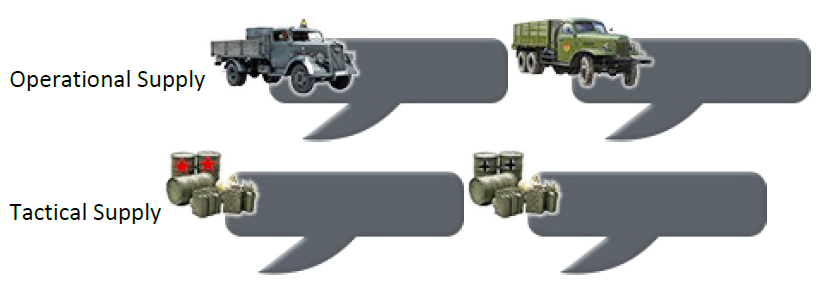
Supply Lines. A supply line is a path of hexes of any length from the unit to the supply source. The path must be free of enemy units and may not pass through impassable terrain hexes. A unit occupying a supply source hex does not need a supply line.
Supply Sources. The operational supply sources provide both operational and tactical supplies to any unit that can trace a supply line to it. To provide supply, the supply source must be controlled by the side receiving the supply. It may not provide supply to both sides simultaneously. Supply source hexes may change hands any number of times during a game.
Operational Supply. At the beginning of each calendar month, a check is made on each unit of both sides to see if it can trace a valid supply line to an operational supply source. The unit is marked with an OOS marker if it cannot successfully trace supply.

The OOS marker remains on the unit throughout the month, regardless of the unit’s ability to trace a supply line during the month. OOS markers have nothing to do with tactical supply a unit in tactical supply with an OOS marker may move its full movement allowance and fight at full strength.
At the end of each month, a further supply check for each unit with an OOS marker is made. If it cannot trace supply at that time to an operational supply source, it is eliminated and removed from play.
Tactical Supply. Tactical supply for a unit is checked each time it moves or engages in combat, including Mobile Assaults. Tactical supply is determined and takes effect at the instant of movement and combat.
A unit without Tactical Supply cannot conduct an Operational Transfer and may use only one-half its printed MF for regular movement.
New Units Phase
German Replacements and Reinforcements. Replacements represent troops and equipment used to replenish units already in play. They will be assigned automatically to your units.
Replacement Schedule. Replacement steps become available during the first German New Units Phase of the appropriate Calendar Month. The German Player automatically receives replacements as follows:
March (Calendar Month 5) — All three Assault Gun Battalions will be brought up to full strength. If a battalion has been destroyed, it will be brought back (as full strength) as a reinforcement unit.
April (Calendar Month 6) — Two mechanized steps will be replaced.
May (Calendar Month 7) — Two mechanized steps and three German non-mechanized steps. In addition, any two destroyed non-mechanized Romanian units will be recreated from the dead pile and brought on as reinforcement units.
Reinforcement units are fresh units entering play for the first time. Except for the 22nd Panzer Division (which enters at its 2 step-strength) and the 197th and 249th Assault Gun Battalions, all reinforcements automatically enter play at their full strength.
All reinforcements for each calendar month become available during the first German New Units Phase of that month, except air units, which are available during the first Soviet New Units phase of April (Calendar month 6). The units may be brought onto the map during any New Unit phase of the month.
Russian Reinforcements. The Russians only receive reinforcements. They do not receive replacements.
Operational Transfers
Operational Transfers (OpTrans) are a form of movement that allows units to move much farther than they could using regular movement.
Any unit in Tactical Supply at the start of the OpTrans Phase may conduct an OpTrans. A unit conducting an OpTrans has an unlimited number of MPs, so it may move from any point to any point on the map in one move.
It may start the phase adjacent to an enemy unit. The unit may not enter any hex it could not enter using regular movement, nor may it conduct an MA. It must stop as soon as it enters a hex next to an enemy unit, even if it is the same enemy unit it started next to, and even if a friendly unit is already in the new hex. It may not move during the following Movement Phase.
In the following Combat Phase, it may not conduct a PA or barrage (for artillery units). It defends and may retreat normally in the following enemy Player Turn.
No OpTrans may be conducted during the first calendar month. Movement Phase
Movement
Every ground unit in the game has a “Movement Factor” printed in its bottom right corner. The Movement Factor is the number of Movement Points (MP) available to the unit. The unit moves by expending MPs for each hex it enters. The MP cost to enter a hex depends on the terrain in that hex.
All units are guaranteed the ability to move at least one hex during each movement phase by expending all available MPs. This guarantee does not apply to units that conducted an Operational Transfer or are attempting to conduct a Mobile Assault.
Supply. Immediately before a unit starts moving, a check is made to see if it is in Tactical Supply. Units with no tactical supply at that instant move that turn with only half their printed movement factor.
Movement of Stacks. To move together, units must start the Movement Phase already stacked together. Units are not forced to move together just because they started the phase stacked together, but may move off individually or in smaller stacks.
If units with different movement factors are travelling together in a stack, the stack will use the MF of the slowest unit.
Terrain. There are two kinds of terrain in the game: natural and manmade. There are five types of natural terrain that affect play: Clear, Broken, Hill, Marsh, and River. The first four exist within a hex; rivers exist along hexsides. Each hex contains only one kind of natural terrain. There are 6 kinds of manmade terrain: Entrenchments, Fortifications, the city of Sevastopol, Towns, Large Towns, and railroads. Any number of these terrain types may exist in a given hex.
Terrain Effects on Movement. Manmade terrain does not affect movement. The type of natural terrain in a hex or along a hexside determines the number of MPs required to enter the hex or cross the hexside. These MP costs are summarized on the Terrain Effects Chart. Note that MP costs for some terrain differs for mechanized and non-mechanized units.
Weather. There are three kinds of weather in Krim: clear or normal, Mud, and Frost. Weather makes itself felt in the game primarily through the different number of Player Turn Couplets in each calendar month, but here are some additional effects of Mud and Frost. December, March & April are “Mud” months, and January & February are “Frost” months.
Mud. No Mobile Assaults are allowed. Crossing river hexsides costs 1 MP in addition to the cost of entering the hex.
Frost. Mobile Assaults may be launched into Marsh terrain. Soviet units entering play via the Kerch Straits may continue their movement after crossing.
Railways and Railroad Artillery. The only purpose of the railroads running south out of Dzhankoi is to govern the movement of the German Player’s railroad artillery. Those units will only move and retreat along German-controlled railroad hexes.
Mobile Assault
Mobile Assaults (MA) are a special form of combat which occurs during the movement phase. To conduct an MA, attacking units from one hex (only) attempt to enter one (only) enemy-occupied hex, paying triple the normal MP cost to enter that hex. Combat is resolved normally. A unit may make more than one MA per Movement Phase if it has sufficient MPs to do so but must cease movement if it absorbs any combat result as a retreat.
Eligible Units. All German mechanized units, excluding the 300th Panzer Regiment, may make MAs. German infantry, Jaeger and combat engineer units may make MAs when assisted by assault guns. The Romanian Kame Regiment may conduct an MA if it is stacked with a German unit conducting the same MA. No Soviet units may make MAs.
Movement Costs, Terrain & Weather. Units making an MA must pay triple the normal MP cost to enter the hex into which they are attacking. MAs may not be conducted during Mud months. MAs may only be launched into Marsh terrain during Frost months. No MAs may ever be launched into Broken or Hill terrain.
Stacks. To conduct an MA together, units must begin the Movement Phase stacked together.
Resolution of MAs. MAs are resolved in the same way as Prepared Assaults. The combat takes into account
Tactical Supply, the terrain in the defender’s hex, and any air power used by either side.
A defending unit or units may be the target of more than one MA in the same phase, by one or more attacking units or stacks.
Supply. Tactical Supply for the defending units is determined at the instant of combat. Tactical Supply for the attacking units is determined at the start of their move.
Air Support. Air units may be committed to MAs by both sides. Normal air support rules apply. Use of an air unit in an MA (attack or defense) constitutes use of that air unit for the turn.
Advance After Combat. There is no advance-after-combat after an MA. Units conducting MAs may continue their movement as long as they have MPs available and have not absorbed any of their combat result as a retreat.
Both Sides Survive. In cases where both sides absorb their full combat result as step losses and there are surviving units from both sides, the moving player has two choices: 1) If the attackers have sufficient MPs available to conduct another MA, they may conduct another MA immediately.
Infantry units may conduct only one MA per movement phase and must cease movement after conducting the MA. They may conduct a Prepared Assault in the subsequent combat phase.
Soviet Sea Movement, Landings & the Kerch Straits
Soviet Sea Movement. The Soviet Player has the capacity to move up to 5 divisions by sea during each of his Player Turns. Units using Sea Movement must start the movement phase in the Quick Reaction Box (QRB). Units may be transferred between the QRB and the Soviet Reinforcements Available box during the Soviet New Units Phase. No more than 5 divisions may be in the QRB at any time. For purposes of sea movement only, each artillery or tank unit counts as a full division.
Units in the QRB may enter play at any time during the Soviet Movement Phase. They enter by landing in any Soviet Operational or Tactical supply source hex, even if the hex is German-controlled at the instant of landing. The unit may move no further in that movement phase but may attack and advance after combat in the subsequent combat phase. If a German or Romanian unit occupies the landing hex, the landing is opposed. The Sea Movement capacity is lost at the start of Calendar Month 8 (JUN /JULY).
Sevastopol Geography. Due to the geographic features of Sevastopol Harbor (too small to show clearly on a map of this scale), Sea Movement into and out of Sevastopol is prohibited any time a German or Romanian unit occupies hex C7. This restriction does not apply to supply or emergency combat intervention.
Sea Transfers. A Sea Transfer is a special form of Sea Movement. Any unit moved by transfer counts against the 5-division limit.
Any Soviet unit starting a Soviet Movement Phase in a Tactical or Operational supply source hex may be moved to any other Soviet-controlled supply source hex or to the Quick Reaction Box. The unit may have conducted Op Trans in the preceding OpTrans Phase. Sea Transfers should be conducted before any other movement. A sea-transferred unit may not move in any other way the same Player Turn. It may not attack, but does defend and may retreat normally.
The Kerch Straits. The Kerch Straits is the narrow and shallow body of water separating the Crimea from the mainland in the east. The hexes starred on the map from the western coast of the straits. Soviet units from the Soviet Reinforcements Available box may enter any of those hexes at the start of the Operational Transfer Phase or at any time during the Soviet Movement Phase. Units entering in the OpTrans Phase may use OpTrans in the same phase. Units entering during the movement phase may not move further in the same movement phase, but may attack and advance after combat in the subsequent combat phase. Stacking limits must be observed at the moment of placement.
Units entering during the movement phase may attempt to enter an enemy-occupied straits hex.
Frost. During Frost months (January and February), units entering during the movement phase do not have to stop on entering play via a straits hex. The units pay 1 MP to enter the hex and may continue moving normally.
Opposed Landings. To conduct an opposed landing, move the Soviet units into a sea hex next to the desired landing hex during the movement phase. In the subsequent combat phase, resolve the combat normally, subject to the restrictions in this section.
Opposed landings must be resolved before any other combats. Landing units may advance after combat normally. Units making an opposed landing may cooperate in the attack with units already on land. Shift the odds one column left (in the defender’s favor). If the attack fails to clear the desired landing hex, the surviving attackers are returned to the Soviet Reinforcements Available box.
Combat Phase
During his Combat Phase, each player’s units may attack adjacent opposing units. The player making the attacks are the attacker and the other player the defender, regardless of the overall situation.
Attacks (called Prepared Assaults or P As to distinguish them from German Mobile Assaults) are always voluntary. The attacker may make as many or as few PAs as he wishes
No attacking unit may be involved in more than one PA in a given Combat Phase, and no enemy unit may be attacked more than once per Combat Phase.
A stack of units defending a hex must be attacked as a single unit. Attacking units stacked in one hex need not all attack, nor need they attack into the same hex.
Attacking units in two or more hexes may attack together into a single hex.
Further Combat. If a unit retreats into a hex in which other units are involved in a PA later in the same combat phase, the retreated unit does not contribute to the defense of the new hex. If the subsequent combat yields a combat result above zero for the units already in that hex, the previously retreated units are automatically destroyed.
Advance After Combat. After any PA (only, not after an MA) in which the defending hex(es) are emptied of defending units, whether by elimination or retreat, the victorious attacking units may advance after combat. Advances are not considered part of regular movement, but are counted in Movement Points, not hexes. The victorious attackers are awarded 1 MP per hex retreated by the defeated defending units. If the defenders were eliminated, the attacker receives 3 MP. A victorious unit may always advance at least one hex, regardless of the MP cost of the hex entered.
Restrictions. Advancing units may not enter prohibited terrain. The first hex of the advance must be into the vacated defender’s hex. In cases where defending units occupied more than one hex, the advancing unit(s) need enter only one of the vacated hexes. Units with no tactical supply and Romanian units may never advance more than one hex. Artillery units may not advance after combat under any circumstances.
Terrain Effects on Combat. Only the terrain in the defender’s hex affects combat results. The effects of natural and manmade terrain are separate and therefore cumulative.
All effects are summarized on the Terrain Effects Chart (section 9).
Concentric Assault. If a single hex of defenders is attacked by units in opposite hexes, or by units in three hexes with at least one hex between two of them, or by units in more than three hexes, +1 is added to the Defender’s combat result.
Supply. Any unit participating in combat that is not in Tactical Supply has its combat factor (attack or defense) halved.
Air Units & Air Support
General. The air units represent agglomerations of ground attack aircraft. They may participate in MAs and PAs, both on attack and defense. Each air support unit may participate in one combat support mission per player turn couplet.
These aircraft are considered to be based safely off map for both sides, have no range or movement restrictions, and are never eliminated.
Commitment. Air support units are committed to a battle after the odds are calculated.
Effects. Each air unit committed to an attack raises the defender’s combat result by one. Each air unit committed to the defense lowers the defender’s combat result by one. Opposing air units cancel each other, one-for-one.
Restrictions. The Soviet Player may never commit more than one air unit to a given battle.
Artillery and Barrages
Artillery Units. The following rules define the differences between artillery units and the other combat units in the game. Unless mentioned here, artillery units are treated just like the other units.
Movement. Artillery units that conduct operational transfers may not fire barrages.
Railroad Artillery. The units with”*” for a movement factor are railroad guns. They may move only on German-controlled rail hexes and have an infinite movement factor along rail lines. They may not conduct operational transfers. They cannot retreat from the rail lines.
Combat. Artillery units may only attack by firing barrages. Artillery units defend normally. Artillery never advances after combat, either normal or barrage.
Supply. Artillery units must be in tactical supply to fire a barrage.
Range. Some artillery units may attack non-adjacent enemy units. The range factor indicates how many hexes the guns can shoot; do count the target hex, do not count the firing artillery unit’s hex.
Barrages. Each artillery unit may fire once in its combat phase and once during the enemy combat phase. The firing artillery unit must be in tactical supply. If adjacent to an enemy non-artillery unit, the firing artillery unit must be stacked with a friendly non-artillery unit to be able to fire a barrage.
All barrages must be resolved before any prepared assaults are resolved. Each enemy-occupied hex may be the target of only one barrage per Combat Phase.
Barrage Results. The only two barrage results are a hit has been scored, or no effect. If a hit is scored, one step in the target hex is eliminated.


